Explore Cooling System by vehicle brand

What Cooling System components do

The cooling system holds the engine within a narrow temperature band: hot enough to run efficiently and burn off condensation, cool enough that the oil film survives and the head does not distort. The radiator is the main heat exchanger in that circuit. On automatics it frequently doubles as a transmission oil cooler, and on hybrid and battery-electric vehicles there are additional low-temperature circuits handling power electronics and battery conditioning.

Radiator part numbers are driven by core dimensions, the position and diameter of the inlet and outlet necks, and whether the unit includes an integral transmission oil cooler. Manual and automatic versions of the same model therefore usually take different radiators, and air-conditioned cars often use a thicker core. Material matters as well: almost all current radiators are aluminium cores with crimped plastic end tanks, and that crimp seam is where they eventually fail. Coolant choice is not a detail — mixing incompatible coolant technologies, or topping up with plain water, promotes electrolysis and internal scaling that will destroy an aluminium core from the inside regardless of how well it was made.

Radiator

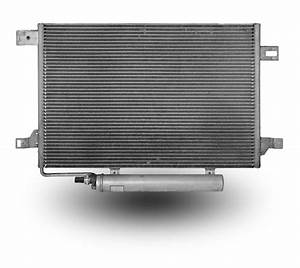
The radiator transfers heat from engine coolant to passing air. Most modern units use an aluminium tube-and-fin core with moulded plastic end tanks crimped on over a gasket. Vehicles with automatic transmissions often have a transmission oil cooler built into one tank, and hybrids and battery-electric vehicles carry additional low-temperature circuits for power electronics and battery conditioning.

The plastic-to-aluminium crimp seam is the usual failure point: heat cycling embrittles the plastic until the tank cracks or the gasket takes a set. Cores also block internally with scale and casting debris when coolant is not changed, and externally with dirt and insects. Using the wrong coolant, or mixing types, promotes electrolysis that eats the aluminium from the inside.

  • Coolant loss with no visible external leak, or a sweet smell and white crusty residue along the end-tank seam.
  • Temperature climbing in traffic but settling on the move, which points to airflow or fan problems as much as to the radiator itself.
  • The cabin heater blowing cold at idle — a classic low-coolant symptom.
  • Oily residue in the coolant on automatics, meaning the internal transmission cooler has ruptured.

Give core width, height and thickness, the position and diameter of the inlet and outlet necks, whether there is an integral transmission oil cooler, and whether the vehicle is manual or automatic and has air conditioning. All four change the part number.

Checks to make before you order

A few minutes of inspection prevents most wrong-part returns in this category.

  • Pressure-test the system cold rather than looking for drips. Many end-tank seam leaks only weep under pressure and evaporate before they reach the ground.
  • Look for white or coloured crusty deposits along the plastic-to-metal crimp and around the neck seals.
  • Check the fins for impact damage and for blockage by dirt and insects; a physically sound radiator with a blocked face will still overheat in traffic.
  • On an automatic, look for oil in the coolant or coolant in the transmission fluid, which indicates the internal cooler has failed.

Identifying the right part by OEM number

An OEM number is the vehicle manufacturer's own part number for a component. It is normally printed, stamped or moulded onto the original part, or onto a label attached to it. Aftermarket manufacturers publish cross-references linking their own catalogue numbers to those OEM numbers, and that cross-reference is what makes an order verifiable rather than an educated guess.

Cross-referencing matters because a single model line rarely uses a single part. Over a production run a manufacturer will change suppliers, revise a design mid-life, fit larger brakes to a heavier or higher-output variant, and build market-specific versions with different lighting, sensors and emissions equipment. Two vehicles that look identical in a showroom photograph can therefore take different parts. The model name narrows the search; the OEM number closes it.

Frequently asked questions about Cooling System parts

Do manual and automatic versions take the same radiator?

Usually not. Automatic transmissions are commonly cooled by a heat exchanger built into one of the radiator end tanks, which adds two extra fittings and changes the part entirely. Always state the transmission type when asking for a radiator.

Can a plastic end tank be repaired?

Not reliably. The crimped joint between an aluminium core and a plastic tank is not a serviceable seal, and epoxy repairs on a pressurised, heat-cycled component fail quickly. Replace the radiator.

My temperature gauge rises in traffic but is fine on the move. Is the radiator blocked?

It might be, but that symptom is equally consistent with a failed cooling fan, a fan relay or control module fault, or a blocked radiator face. At road speed there is enough ram air to mask a fan failure. Confirm the fan runs before condemning the radiator.

Does the coolant type really matter?

Yes. Coolant technologies use different corrosion inhibitor packages, and mixing them can drop the inhibitors out of suspension and leave you with a system full of gel. Topping up with plain water dilutes the inhibitor and lets electrolysis attack the aluminium core. Use the specification the manufacturer calls for.

What do you need to quote a radiator?

VIN, model year, engine variant, transmission type, and whether the vehicle has air conditioning. Core width, height and thickness measured from the old unit, plus the inlet and outlet positions, will confirm the match.

Request Quote